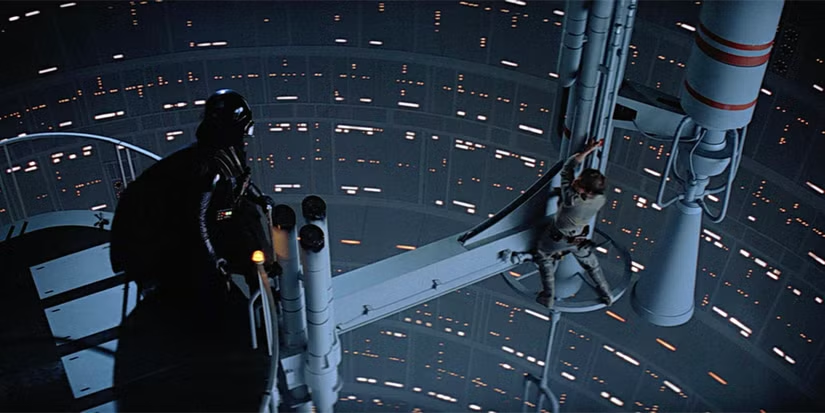
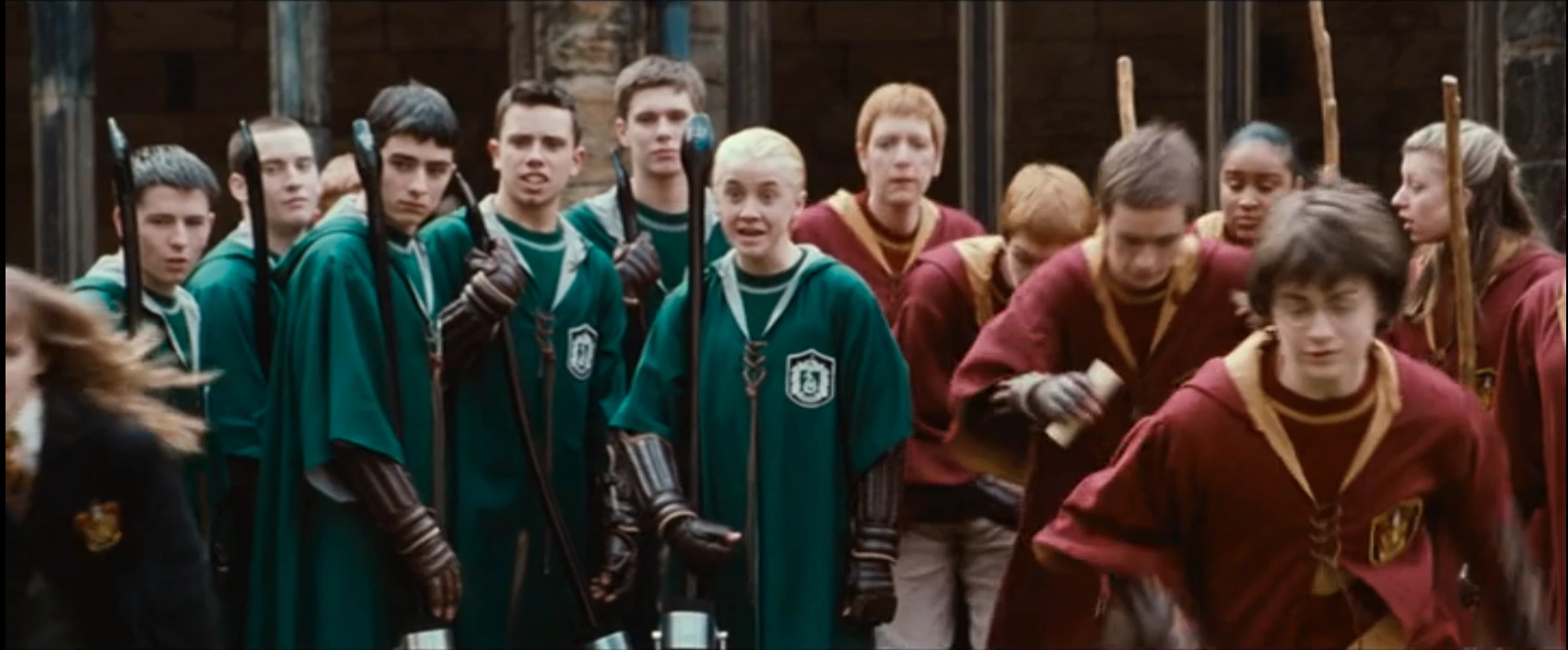
If you are reading this, it probably means that you are new to home theater and are wondering about widescreen movies on DVD. In this primer, I hope to do four things: First I will explain in simple terms the differences between movies presented in widescreen and pan & scan (or full frame). Second, I will lay the groundwork for an understanding of "aspect ratios." Thirdly, I will describe the advantages of viewing a widescreen movie on DVD (or VHS for that matter). Finally, I will explain why widescreen should be the preferred option for those wanting to bring the true theater experience into their homes.
THE BASICS
To begin, I think it's necessary to explain that in the opinion of many, the ultimate goal of any home theater enthusiast is to recreate, as closely as possible, the presentation of a movie in the theater under the best circumstances with the audio/video equipment you have. When I say "best circumstances" I refer to a theatrical presentation in which the quality of the theater's audio and video equipment can accurately present the respective information stored on a clean, new reel of film.
With all this in mind, let's take a trip to our local movie theater. Now, I'm sure we all realize that the screen at the theater is bigger than your average television set; that goes without saying. However, most people don't realize that the shape of the screen differs as well. In every theater, the screen is shaped like a rectangle. That is, it is much wider than it is tall. Here's an example of a typical movie screen:
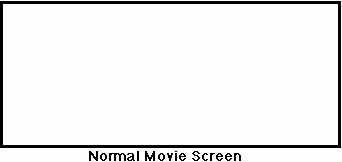
In this instance, the width of the screen is more than two times its height. Filmmakers use these wide frames to create images that play off of our peripheral vision and thus seem more natural than an image that might be contained within a tight square. Now take a good look at your standard television set. It should look something like this:
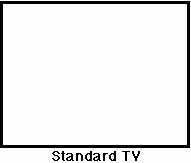
As you can see, it is not nearly as wide as the theatrical screen shown above. It is more square-like, although it is not a perfect square (it is a tad wider than it is tall). This presents an interesting problem. When a film is converted to home video, how do you fit that wide image you saw in the theater into a square? Traditionally, movie studios have adopted a technique known as pan & scan (P&S), which locates the "center of interest" of the image and fits in it the space available on your TV like this:
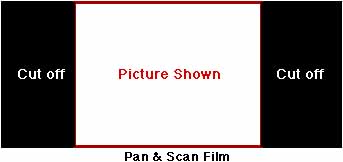
As you can see, this process allows the image to fill up the screen, but at a price. Much of the picture's side is chopped off, destroying the original composition of the scene as it appeared in theaters. As we shall see in a bit, the lost visual information can have a tremendous impact on the movie, as it removes entire characters from scenes and reduces the overall scope of the film.
While most every film has found its way to home video in the form of P&S-only titles, there is an alternate method of presenting movies at home. This method, called letterboxing, preserved the entire image as it was originally seen in theaters. Instead of trying to fill up the screen, this technique fit the width of the film within the boundaries of a typical television set, so that the image appeared to be a strip, running through the middle of the screen, with black space occupying its top and bottom.
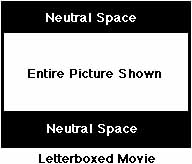
Although the image does appear smaller and does not fill the entire screen, it does preserve the movie's original theatrical composition. When seeing a letterboxed film, many people assume that the black bars on the top and bottom are covering up part of the picture, but as we can see from this illustration, they are nothing more than unused space.
To give you a better idea of how cropping the picture for a P&S video affects the presentation of the movie, here are some examples from various movies. These are actual screen captures of wide screen and P&S videos.
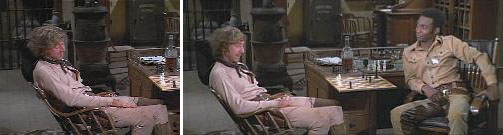
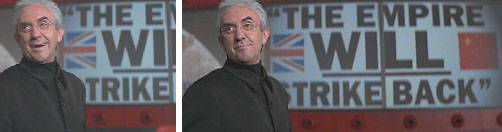
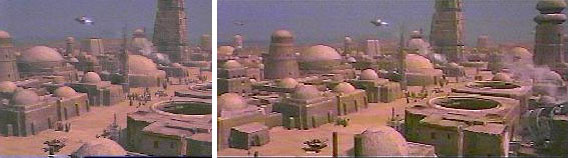
All screen captures are taken from The Widescreen Advocacy Page (widescreen.org)
As you can see, presenting movies in their original widescreen format offers several advantages. It ensures that all characters that should be present in a shot can be seen. This is especially important if two characters are interacting with each other at opposite sides of the screen. It also preserves the composition of the theatrical image so that scenes will feel less claustrophobic than before. Often in a P&S transfer, a close shot of one or more actors can seem unnaturally tight. A good widescreen transfer will allow for some breathing room, so that we can also see the space around an actor. A third advantage is that it allows you to see visual effects in their entirety. As we can see in the example from Star Wars Special Edition, the entire scope of Mos Eisley is not apparent until the widescreen version is viewed.
AN EXPLANATION OF ASPECT RATIOS
Now that we've established that movies are presented on a screen that is wider than that of a standard TV and seen how destroying the composition of the original theatrical image can hurt the movie-watching experience, we should look at the subject of aspect ratios. An aspect ratio simply put, describes the dimensions of a TV or movie screen. It is usually described in terms of width by height. For example, the standard TV set is built with an aspect ratio of 1.33:1 (or 1.33x1). This simply means that if it would be 1.33 feet wide if it were 1 foot tall.
Aspect ratios are important because not all movies are filmed in the same aspect ratio. Just take a look at this comparison of the P&S and wide screen version of Monty Python and the Holy Grail:
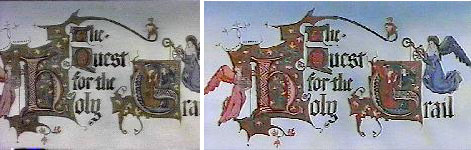
All screen captures are taken from The Widescreen Advocacy Page
You can clearly see that the image is not nearly as wide as those given in the widescreen versus P&S examples given above. Whereas those examples were presented theatrically at an aspect ratio of 2.35:1 (or 2.35 units wide by 1 unit tall), Monty Python and the Holy Grail was filmed at 1.85:1, which is not nearly as wide. The filmmakers decide the aspect ratio of a film and preferences differ from director to director. Often larger epic films, such as Gladiator, Titanic, and Star Wars are filmed with the wider scope of 2.35:1 to create a sense of being larger-than-life. Smaller, more personal films tend to favor the less gigantic 1.85:1 ratio.
Since films shot in 1.85:1 are not nearly as wide, the empty space at the top and bottom of their widescreen presentations on home video will not be nearly as big. Here is a listing of some of the most common aspect ratios (going from squarest to widest):
- 1.33:1 A traditional television set; roughly equivalent to 4:3.
- 1.37:1 Referred to as the academy aspect ratio. The standard for films shot before the mid-1950s. Essentially identical to 1.33:1.
- 1.66:1 A bit wider than a standard TV, but not by much.
- 1.78:1 The dimensions of a widescreen television set; roughly equivalent to 16:9.
- 1.85:1 A popular aspect ratio for many movies.
- 2.35:1 Another popular aspect ratio for movies.
MATTED FILMS AND SUPER 35MM
Now, here's where things get complicated. In the examples presented above it is quite clear that the P&S versions of each movie destroy the intended composition of the theatrical image. Using these examples alone, we see that the black bars associated with letterboxed movies do not cover up any of the picture. Now, take a look at this comparison shot between the widescreen version of The Avengers, a movie shot with an aspect ratio of 1.85:1, and its non-widescreen counterpart.
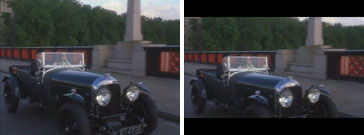
Screen captures taken from Intro to Widescreen
From this shot, it appears as if the side of the image is not chopped off, and the black bars do indeed cover up a portion of the full image. Even more puzzling is this comparison between the two versions of the movie Go, which was shot in 2.35:1.
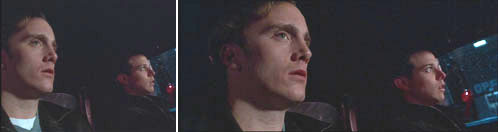
As we can see, both actors are comfortably visible in both versions. If we followed the "rules" of P&S given above, the shot should look something more like this:
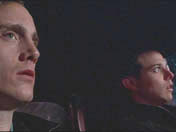
Go screen captures provided by Tomas Cedven.
Was I lying after all? Do the black bars really cover up part of the picture and leave you with nothing more than a half-filled TV? The answer is yes and no. To make sense of that, it is necessary to understand how films are photographed, and how they are transferred to home video.
Most major theatrical releases are shot on 35mm film, which became the standard film stock very early in the history of movies. On 35mm film, the frames for the negative are made with an aspect ratio of 1.37:1, (which as we now know, is roughly the shape of a standard television set), with a small strip included to the side to store audio.
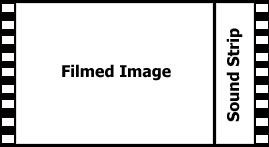
Up until the early 1950s, all films were photographed with a 1.37:1 aspect ratio. This is why you won't see older films like The Wizard of Oz or Casablanca in widescreen. They were not filmed that way.
With the dawn of television in the 1950s, many movie studios feared that no one would come to the theater anymore unless they gave audiences something television could not. So, they developed several technological gimmicks including 3D movies, and more important, the concept of a widescreen film; in other words, one that is presented on a screen wider than 1.37:1.
To create the widescreen effect with 35mm film, several methods were developed. Two remain very popular to this day. The first is called a matte. Basically, a matte photographs a movie using a normal lens and standard 35mm film, but the filmmakers block off the top and bottom to make the image more rectangular, and thus, creating a widescreen effect.
There are two types of mattes. The first, a soft matte, does not block off the top of the frame while shooting the movie. Only later, in the theater or on a widescreen home video, are the additional visuals blocked off to create a widescreen effect. This is why the black bars appear to be covering up part of the picture in the widescreen version. Nothing is lost on the sides, but the intended theatrical composition is still ruined because the objects visible under the mattes were not intended to be seen. The second type of matting is called a hard matte. With a hard matte, the filmmakers have the black bars in place while filming and so no additional images are captured where the mattes would be.
The second method of creating a widescreen movie on 35mm film used especially for films with a 2.35:1 aspect ratios by use of a special lens, which stretches the image vertically to fill the entire frame. This is called an anamorphic lens. While filming a movie, the filmmakers will shoot a scene like this one from Tomorrow Never Dies:
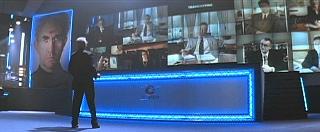
Using a special lens that manipulates the light that goes into the camera, the image is squeezed horizontally.
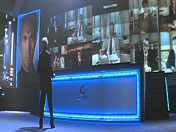
Screen captures taken from The Widescreen Advocacy Page
In the theater, a special lens is applied to the projector to reverse the effect so that we see the image in the theater the way it actually looked on the set.
However, many filmmakers, including Titanic director, James Cameron, have taken a liking to a different process to create a widescreen image, commonly referred to as Super 35. Using this process, the image that the camera takes during filming fills up the entire width of the negative using a spherical lens. (Generally, movies shot with anamorphic lenses do not expose the area where the sound strip ends up.) The lens does not alter the shape of the image that the camera collects. The image taken then has an aspect ratio of approximately 1.65:1, which ultimately gets matted to an aspect ratio of 2.35:1.
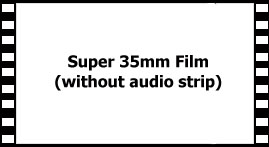
When transferring the movie to home video for a P&S version, the Super 35 image is used, since the additional footage caught on film allows the filmmakers to fill up the entire space of a TV, without resorting to massive cropping. However, the composition of the original theatrical image is still destroyed, because you are losing the intended widescreen effect.
WIDESCREEN TELEVISIONS AND WINDOWBOXING
Thus far, we have discussed the advantages of watching films in their original widescreen formats but only in relation to how the image appears on a traditional 4:3 TV such as this:
However, the emergence of high definition television (HDTV) has brought with it a new kind of TV - one with a much wider frame than a traditional set:
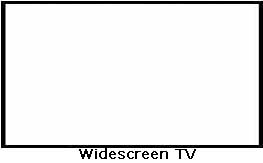
As you can see, this set utilizes a wider screen with an aspect ratio of 1.78:1, more commonly referred to as 16:9. This is the standard aspect ratio for all HDTV material. As we move closer to the digital broadcast age, virtually all big screen TVs on the market are now 16:9.
The purpose of this section is to answer the question, "If I buy a widescreen TV, will it eliminate the black bars on a widescreen movie?" Ultimately, the answer to that is no. A movie that is shot with a 2.35:1 frame...
...will still need to be letterboxed in order to show the entire width of the image on a 16:9 TV.
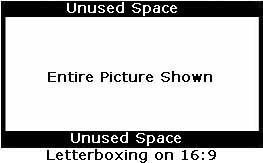
Note that the black bars are smaller than they would be on a traditional TV. Nevertheless, they are still present. Movies shot with an aspect ratio of 1.85:1 will, on the other hand, appear to fill the entire frame of the set.
More importantly, the question arises of what to do with 4:3 material on a 16:9 TV. A movie such as Casablanca will not fill the entire screen on a 16:9 set. Rather than letterboxing the film, the film is windowboxed so that bars occupy the left and right sides of the screen as this illustration shows.
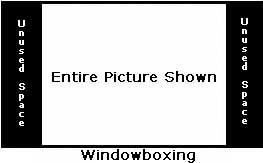
Another option allows users to stretch the 4:3 image to fill the 16:9 frame. For instance, a scene such as this:
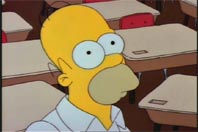
...might appear like this:
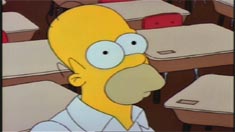
Clearly, there's some distortion occurring here. Homer, who looks normal in the first picture, now looks fatter and squished in the second. No matter how good a stretch mode may be, some distortion is still taking place.
SOME FINAL THOUGHTS
Now that you have a better understanding of what widescreen is and why movies are presented in a letterbox format, I hope that you see not only the advantages of viewing movies this way, but also realize how important it is in preserving both the artistic integrity of the film and the true theatrical experience. In the future I hope you chose widescreen whenever possible. Indeed, the black bars on one's TV are a small price to pay for the chance to see your favorite movies the way they were meant to be seen.
- Jeffrey Forner